Water scarcity and management is central to many environmental challenges and is echoed by Chema customers around India. We recognise that the benefits arising from sustainable practice and processes are two-fold; they are economically advantageous and minimise our impact on the environment.
Innovations in the washing sector and the continued advancement of our pioneering wet processing solutions are supporting quarry operators and materials processors alike to overcome the challenges stemming from water management; cost-based, efficiency, sustainability, and regulatory.
Our modular wet processing equipment can contribute to the easing of water scarcity issues arising from the materials processing industry's consumption of water resources, greatly improve water efficiency, and better wastewater management practices. Developing technological solutions to tackle these mounting challenges is paramount for many materials processors seeking to boost the profitability of their operation by minimising the consumption of costly water resources.
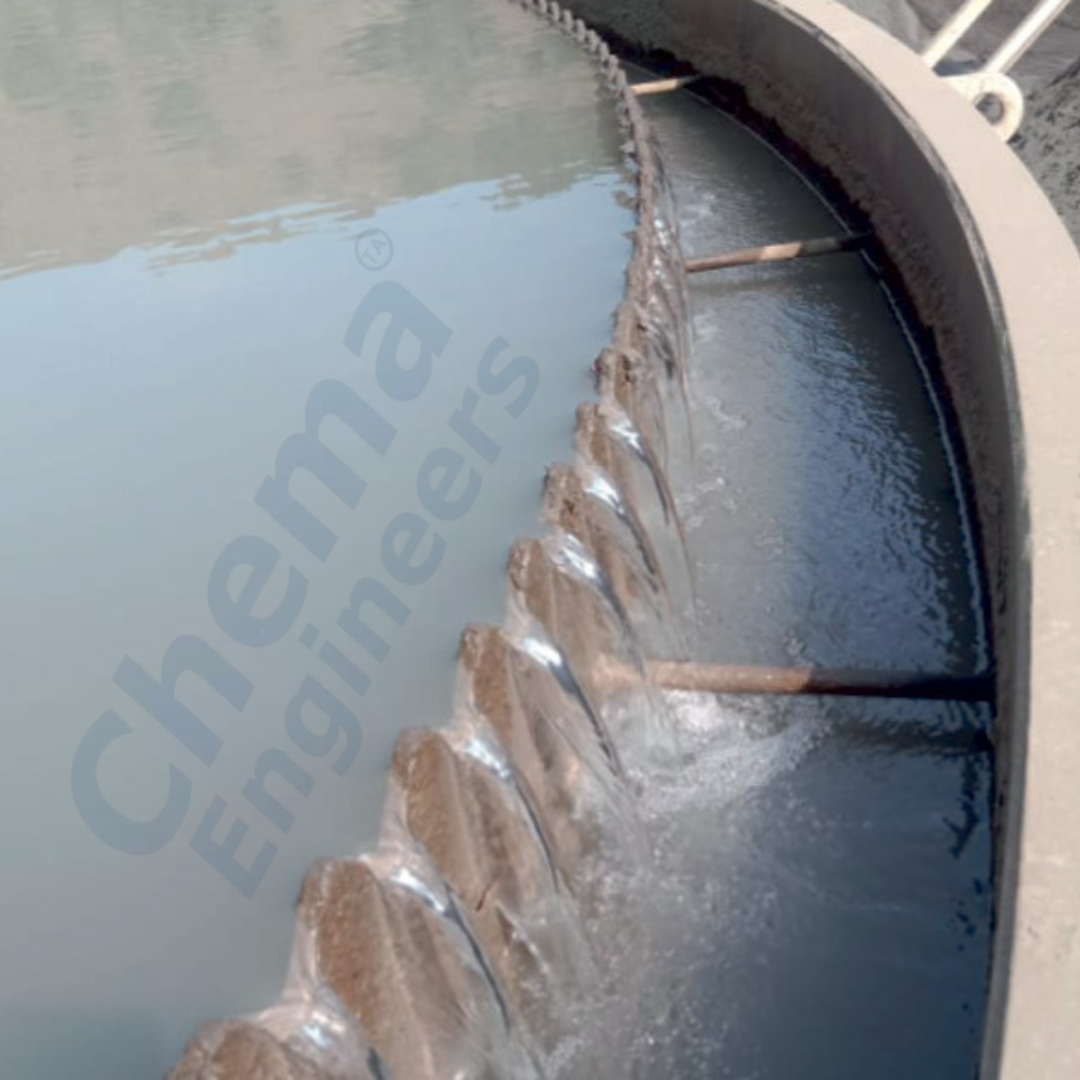
High-Rate Thickeners provide immediately reusable process water and recover approximately 85% of the water from an effluent feed. This high level of water recovery keeps water consumption at sustainable levels, as well as drastically reduces the slurry volume reporting to waste ponds.
High-rate thickeners are high-efficiency industrial machines used to separate liquids from solids via gravity settling. By utilizing specialized flocculants and advanced feedwell designs, they accelerate settling rates significantly, requiring a much smaller footprint than conventional thickeners. The "rake" mechanism plays a crucial role in collecting and moving the settled sludge to the discharge point.
| Specification / Parameter | Details & Capabilities |
|---|---|
| High Efficiency | They increase bulk settling rates by 2 to 10 times compared to conventional thickeners, requiring a volume up to 15 times smaller. |
| Advanced Feedwell | Slurry enters a feedwell equipped with a flocculation chamber, where polymers are introduced to clump particles together without destroying the newly formed flocs. |
| Rake Mechanism | The rake arms are equipped with "plows" that slowly rotate near the bottom of the tank to collect the thickened sludge, consolidate it, and push it toward the central discharge cone. |
| Automated Torque Control | Rakes are supported by heavy-duty hydraulic drives. Because sludge beds can become highly viscous, high-capacity thickeners require rake-lifting mechanisms. If torque becomes too high (e.g., from settled solids), the rakes automatically lift to prevent damage and slowly step down as the bed clears. |
| Commercial Parameter | Value / Policy Details |
|---|---|
| Estimated Price Range | ₹20,00,000 - ₹60,00,000 (Ex-Works Satara) |
| Warranty Period | No warranty on spares/wear parts (Standard industrial terms) |
| Replacement Policy | 7-Day Replacement for manufacturing/size defects. See Policies & Warranty. |
| Standard Lead Time | 6-8 weeks |