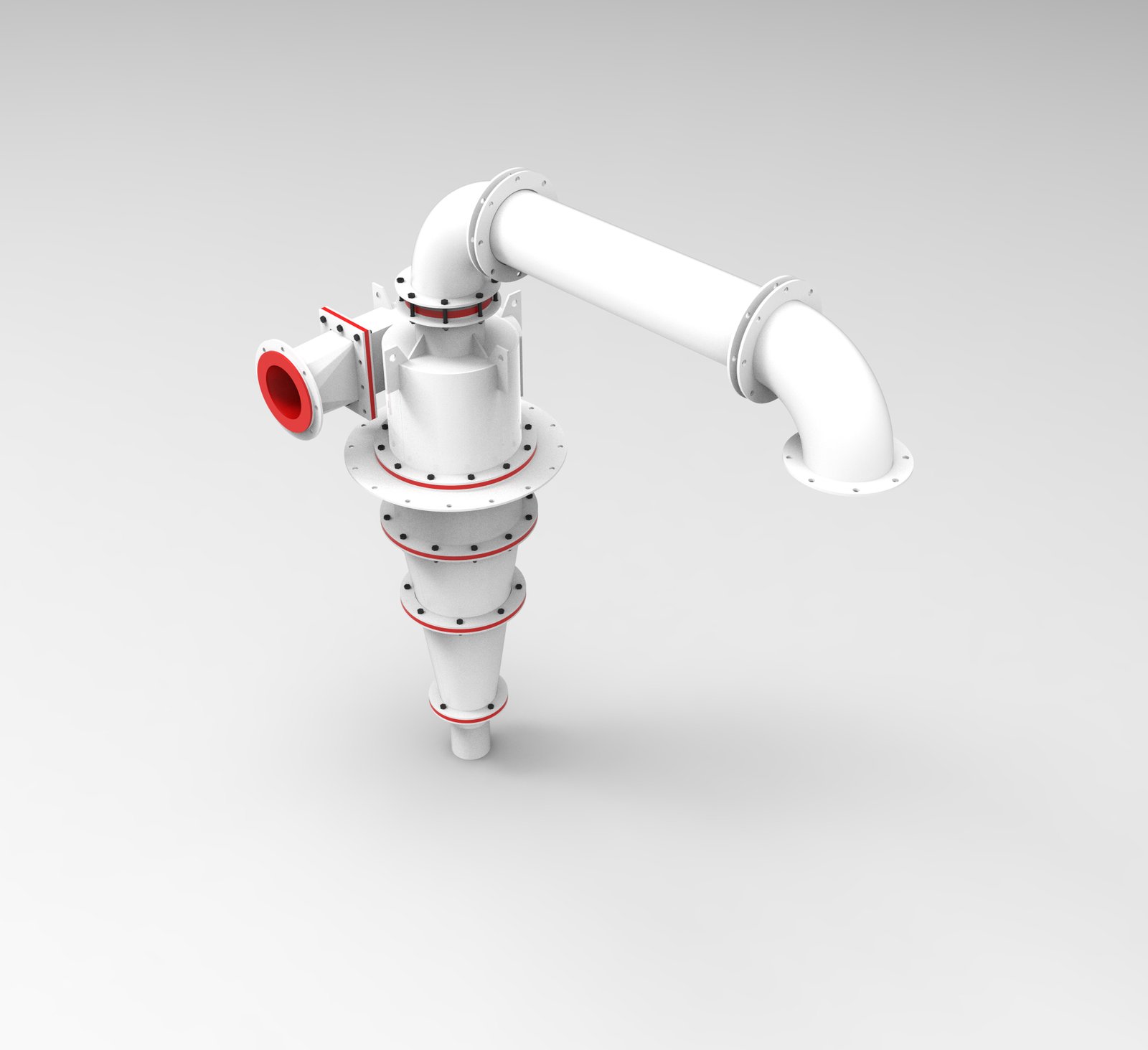
Hydro-cyclones are commonly used for separation, dewatering and sizing of -4 mesh (5mm) particles. They can be used in industries such as sand, aggregates, silica sand, coal washeries, industrial minerals, hard rock mining and more. The use of Hydro-cyclones in washing and stockpiling is common in the construction aggregate industry. Desliming prior to Classification Tanks and Screw Washers can significantly improve the performance of these devices in high fines situations.
For mineral applications such as in hard rock and precious metals processing, Cyclones are the most common equipment to control what size of materials exit the comminution (ball milling) circuit. In these applications, it is the fine fraction in the overflow that is the product. Different ores have different liberation sizes, so Hydro-cyclones are configured in many different ways.
Slurry enters the feed inlet at a designated pressure and volume. Independent of the shape or configuration of the inlet, slurry follows the fall of the upper cylinder in a rotating action. Resultant centrifugal forces send coarser material to the outer wall to travel downward and be further accelerated in the conical sections. These coarser fractions then exit through the apex, or spigot, at the bottom of the Hydro-cyclone. Finer fractions remain rotating with the fluid in the inner core and are removed upward by an air core.
The air core is formed at the spigot/apex as air is drawn into the Hydro-cyclone. The vortex finder provides a pathway for the air to exit the body of the Hydro-cyclone. As the air flows through the vortex finder, the fluids and finer fractions are dragged along to perform the classification of materials. The air core is important for the proper operation of the cyclone. If the air core is not formed due to excessive solids discharge, called roping, the cyclone will not efficiently classify the slurry.
| Design Features | Product Benefits |
|---|---|
| Involute Entry | Less turbulence, higher efficiency, less wear, finer cut point |
| Modular Design | Easy maintenance, flexibility |
| Different Cone Angles | Wide range of cut points |
| Lightweight Overflow Pipe | Less Installation & maintenance time |
| Simple Fastening Arrangements | High range of abrasion resistance, longer life, wide application area |
| Radial / Manifold / Mushroom Arrangement | Compact & efficient cluster design |
| Commercial Parameter | Value / Policy Details |
|---|---|
| Estimated Price Range | ₹50,000 - ₹3,50,000 (Ex-Works Satara) |
| Warranty Period | No warranty on spares/wear parts (Standard industrial terms) |
| Replacement Policy | 7-Day Replacement for manufacturing/size defects. See Policies & Warranty. |
| Standard Lead Time | 2-3 weeks |